
Turaco TTS: Exploring Conversational Speech Generation for Cameroon Pidgin

I’ve been working on Turaco for about two years now. A lot of that time has been spent trying ideas, running experiments that didn’t work, and going back to try something different. There have been plenty of false starts. This is the result that finally made me want to sit down and share where things are going.
Turaco is a family of models and a research initiative exploring language and speech technology for low-resource and underrepresented African languages. The question that keeps bringing me back is simple: what would it take to build tools that feel natural and useful in the languages people actually speak every day?
The model I’m sharing here is Turaco-csm-tts-wes-1b, a one-billion-parameter text-to-speech model that generates spoken Cameroon Pidgin English (WES) from text. It’s one part of that broader effort, and the latest thing I’ve been experimenting with.
What made me want to write this post was listening to it. I could type a passage in Pidgin and hear it come back as speech. After so many attempts that didn’t go where I hoped, I came away more impressed than I expected to be at this stage.
That was a breakthrough moment for me in this project. Something I’d been thinking about and working toward had become tangible enough to listen to, question, and share.
This post is a snapshot of where I am with that work. I’m sharing the audio, the setup, and the numbers so you can explore it with me.
A small run inside a bigger project
This checkpoint is Turaco CSM TTS wes 1B. It builds on Sesame’s CSM through Unsloth’s CSM 1B checkpoint, which I adapted using Cameroon Pidgin recordings. It’s one experiment within the wider Turaco effort.
Here’s what went into this run:
| Pilot setup | |
|---|---|
| Model | Turaco CSM TTS wes 1B, adapted from Sesame CSM |
| Language | Cameroon Pidgin |
| Training data used | 400 recordings from one speaker |
| Training | 60 optimizer steps on a Tesla T4 |
| Recorded training time | 228.34 seconds |
| Validation | Teacher-forced loss decreased from 6.102 to 5.130 on 32 recordings |
The training time above excludes data preparation, model loading, evaluation, and export. On the same 32 validation recordings, teacher-forced loss fell from 6.102 to 5.130, a 15.93% relative decrease. I’ll get into what that number means below. What first made me want to share the experiment was hearing the outputs.
Explore Turaco on Hugging Face →
Listen to it
I wanted to go beyond a training-loss curve and put the two checkpoints next to each other. Below are the base model and Turaco reading the same text. I’ve left in all nine comparisons: three longer passages, followed by everyday phrases, names and places, numbers, code switching, and punctuation.
The passages are inputs I gave the model to read. The model isn’t writing these stories; it’s generating the speech.
For each pair, I kept the text, speaker ID, seed, sampling settings, and generation budget identical. All samples below use seed 3407. These examples use text-only conditioning, without an audio reference. They’re a separate comparison from the reference-conditioned examples in the original training experiment.
Longer passages
01. Market Story
| Item | Sample |
|---|---|
| Text | Massa, make I tell you weti happen yesterday. I bin di go for market when rain just start fall. I no even get umbrella, so I run go hide for one small shop. When rain stop, I come see say I don forget my phone for house. Chai! Na so my day just spoil. |
| Before training | Listen · 16.24s |
| After training | Listen · 21.52s |
02. Community Message
| Item | Sample |
|---|---|
| Text | Good morning, my people. Make we remember say tomorrow we get meeting for community hall. Everybody fit bring idea about how we go keep our quarter clean. If you no fit come early, no worry; just join we when you free. Small small, if all man put hand, we fit make better change for the place wey we di live. |
| Before training | Listen · 27.36s |
| After training | Listen · 27.60s |
03. New Technology
| Item | Sample |
|---|---|
| Text | This morning, ma small sister bring one new machine for house. She type message for Pidgin, then the machine read am loud, and all man stop weti e bin di do. Papa laugh, shake e head, and ask make she try another story about how we bin di carry water when we be small. |
| Before training | Listen · 17.12s |
| After training | Listen · 18.72s |
Everyday phrases and edge cases
04. Everyday
| Item | Sample |
|---|---|
| Text | I di kam na for kam. |
| Before training | Listen · 2.32s |
| After training | Listen · 6.72s |
05. Soya Question
| Item | Sample |
|---|---|
| Text | Dey di bon soya. No be so? |
| Before training | Listen · 2.32s |
| After training | Listen · 3.28s |
06. Places
| Item | Sample |
|---|---|
| Text | Massa, we go meet for Bamenda before we travel go Buea and Douala. |
| Before training | Listen · 5.92s |
| After training | Listen · 8.48s |
07. Numbers
| Item | Sample |
|---|---|
| Text | Na 2026 dis. I buy 3 book dem for 2500 francs, and we go meet for 7:30. |
| Before training | Listen · 13.04s |
| After training | Listen · 11.36s |
08. Code Switch
| Item | Sample |
|---|---|
| Text | Abeg, send me that email before meeting start. I go check the document when I reach house. |
| Before training | Listen · 5.84s |
| After training | Listen · 9.68s |
09. Punctuation
| Item | Sample |
|---|---|
| Text | Eh! You don hear? Wait small... No rush. We go do am together, one step after another. |
| Before training | Listen · 9.44s |
| After training | Listen · 10.08s |
What to listen for: pronunciation, pacing, repeated or omitted words, and whether each recording reaches the end of its text. The passages are text inputs rendered as speech, rather than stories written by the model.
What the numbers say
The training result
I measured validation loss before and after training on the same 32 held-out recordings. Those are two endpoint measurements, alongside the training history shown here.
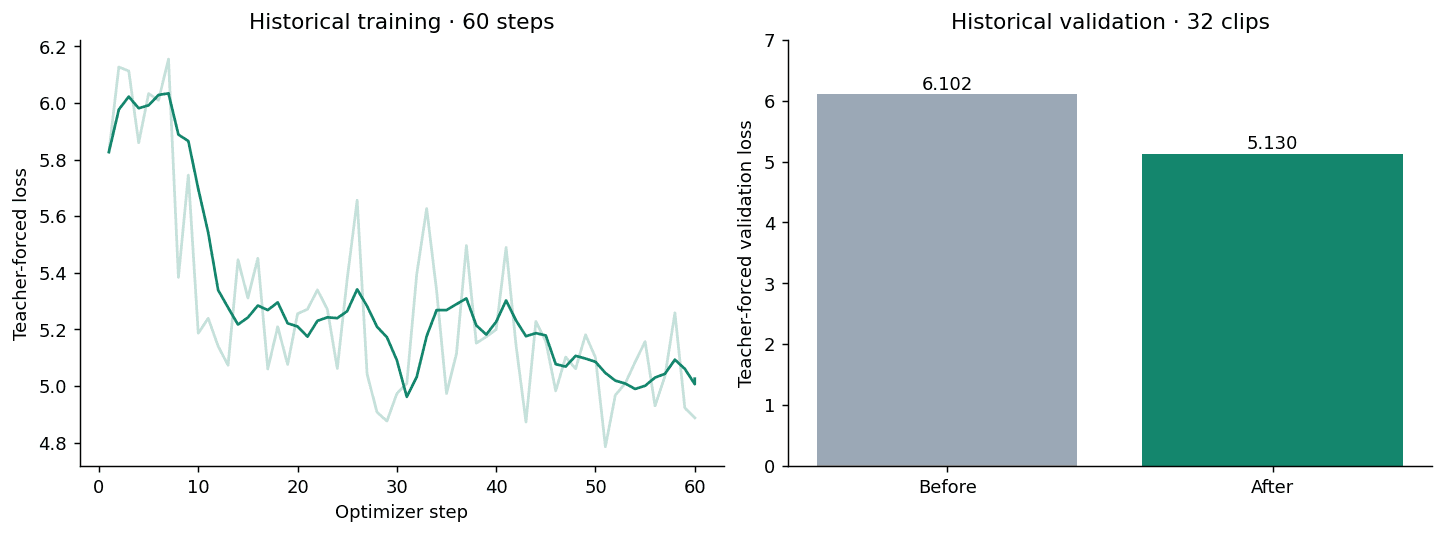
| Historical training measurement | Result |
|---|---|
| Training / validation recordings used | 400 / 32 |
| Optimizer steps / effective epochs | 60 / 1.2 |
| Training phase runtime | 228.34 seconds |
| Baseline validation loss | 6.102216 |
| Final validation loss | 5.130048 |
| Relative validation-loss decrease | 15.93% |
The decrease gives me a useful signal to investigate. Teacher-forced loss measures prediction with the target context supplied. A 15.93% decrease doesn’t mean the voice sounds 15.93% better, or that pronunciation improved by that amount. To answer those questions, I need listening evaluations.
I haven’t scored the original 51 test recordings. These hand-picked prompts are also a small inspection set, rather than an established language benchmark.
Runtime and generation checks
I also wanted to see what happened across different kinds of prompts. My comparison notebook saves every attempt, including generation errors, so I can inspect the whole small suite.
| New inference result | Before | After |
|---|---|---|
| Successful files / attempts | 9 / 9 | 9 / 9 |
| Files near generation budget | 0 | 0 |
| Median real-time factor | 3.115 | 3.125 |
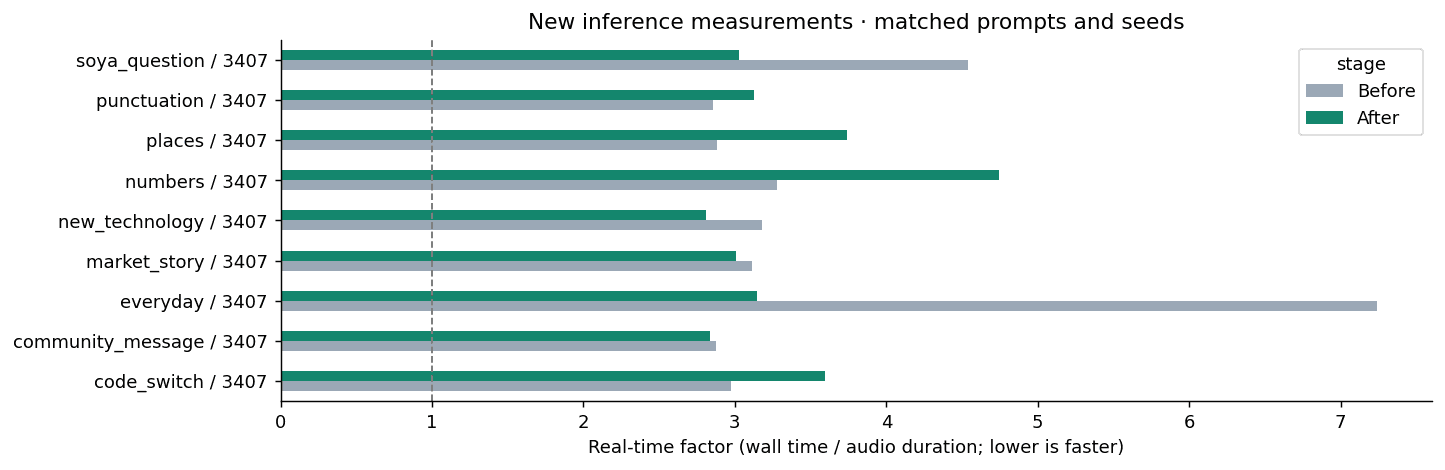
Real-time factor is wall time divided by generated audio duration. Here it includes input preparation, generation, and transfer to CPU, and excludes model loading, warmup, file writing, and notebook playback. Shorter or truncated output can affect that ratio, so I treat these as descriptive timings for this session’s hardware. They don’t tell me how natural the speech is or how a deployed service would perform.
I haven’t entered listening ratings for this suite yet. My excitement about the outputs is a personal reaction; I still need an independent evaluation of pronunciation and naturalness.
A little more about the experiment
The data I used
I used Cameroon Pidgin recordings from Common Voice Scripted Speech 27.0. The selected corpus has 998 recordings from one anonymous speaker, about 59.4 minutes in total.
I grouped the splits by transcript: 897 training, 50 validation, and 51 test recordings. This run used subsets of 400 training and 32 validation recordings. That distinction matters: the full selected corpus is larger than the data consumed by this training run.
For the three longer showcase passages, I also checked whether the text appeared in the available fine-tuning corpus. Neither the full passages nor their individual sentences had an exact match against the 998 distinct transcripts after normalizing case, punctuation, Unicode, and whitespace. The report covers the supplied Common Voice corpus and prepared splits. It can’t tell me whether similar text appeared in the base model’s pretraining, or whether the words and concepts were unfamiliar to it. The report is tied to these exact passages; changing them would require another check.
The adaptation
I used LoRA with rank and alpha 32, a learning rate of 0.0002, and an effective batch size of eight. The checkpoint I’ve shared merges the adapters into FP16 weights.
For the audio comparison, I loaded the unadapted base model and the merged Turaco model through the same Transformers interface and precision. That makes this a checkpoint comparison, rather than an exact recreation of the original quantized training-time baseline.
I’ve included the revisions, prompts, seeds, environment, file hashes, raw results, and text-overlap report in the downloadable experiment files linked below. I want the work to be inspectable as I keep iterating.
What I still need to improve
The biggest limitation is the scope of the experiment: one speaker, a small amount of training data, and one short run. I can’t use that to claim coverage of Cameroon Pidgin speakers, accents, spelling variation, conversational speech, or long-form narration. Even though conversational speech generation is the direction I’m exploring, these samples are prompted text-to-speech examples.
I haven’t measured MOS, WER, CER, speaker similarity, or independent blinded listener preference. The longer samples still need careful listening for repeated words, omissions, and cutoffs. I’d encourage you to check whether each recording reaches the end of its text, even where no generation-budget warning was raised.
Here’s where I want to put the next round of work:
- More data, with better cleaning. I need more clean recordings with accurate transcripts, and a broader range of speakers and speaking styles. I want to spend time checking alignment, recording quality, and consistency before simply adding more hours.
- Longer training runs. Sixty steps gave me something worth exploring. I want to train for more rounds and compare checkpoints along the way, using held-out data to see where extra training helps and where overfitting starts.
- More deliberate parameter experiments. I want to vary the learning rate, LoRA rank and alpha, effective batch size, and training duration. I also want to explore generation settings separately, so I can distinguish changes in the model from changes in how I sample it.
- Evaluation with Cameroon Pidgin speakers. I need people to listen, point out what sounds wrong, and compare outputs without knowing which model produced them. I want to know where my own impressions hold up and where they don’t.
I’m interested in where this could eventually lead: narration, educational material, and interfaces people can use in Pidgin. Those are directions to work toward and evaluate as the models develop.
Try it, and tell me what you hear
The checkpoint and processor are on Hugging Face. To try it, load the model with CsmForConditionalGeneration, prefix the text with the speaker ID [0], and generate 24 kHz audio.
If you speak Cameroon Pidgin, I’d especially like to hear which phrases work, which sound off, and what you’d try next. If you work with clean speech data or are exploring similar problems, I’d love to compare notes.
After all the experiments and false starts, I’m excited to have this result to share. I didn’t expect such a small run to leave me this encouraged. Now I want to understand it better, improve it, and keep sharing what I learn.